|

|
* 작성자 : 관리자
* 작성 일자 : 2006.10.27
* 조회수 : 6107
 |
Back to the Drawing Board: Designing Corporate Boards for a Complex World, 2006. 번역출간예정 |
 |
|
|
링크
|
http://harvardbusinessonline.hbsp.harvard.edu/b02/en/common/item_detail.jhtml?id=7761
|
|
|
파일 1
|
hbs-bcg.jpg
|
|
Back to the Drawing Board: Designing Corporate Boards for a Complex World (Hardcover)
by Colin B. Carter, Jay William Lorsch
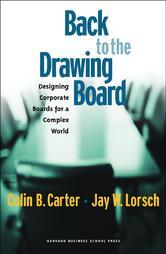
Hardcover: 256 pages
Publisher: Harvard Business School Press (November 21, 2003)
Language: English
ISBN: 1578517761
Product Dimensions: 9.7 x 6.4 x 1.0 inches
Description:
Business scandals from Enron to WorldCom have escalated concerns about corporate governance into a full-blown crisis. Institutional investors and legislators have dominated the debate and enacted important changes in corporate accounting and other areas. But Colin B. Carter and Jay W. Lorsch say that we must now focus on the performance of corporate boards. This timely book argues that boards are being pressed to perform unrealistic duties given their traditional structure, processes, and membership. Carter and Lorsch propose a strategic redesign of boards--making them better attuned to their oversight, decision-making, and advisory roles--to enable directors to meet 21st century challenges successfully. Based on the authors' deep expertise and longtime experience working with boards around the world, and on a probing survey of CEOs, Carter and Lorsch help boards to develop a realistic value proposition customized to the company they serve. The authors explore the core dilemmas and responsibilities boards face and outline a framework for designing the most effective structure, makeup, size, and culture. This book provides a candid account of the current state of boards and points the way in a time of crisis and change.
Subjects Covered:
Corporate governance, Decision making, Ethics.
Corporate boards have been in the public crosshairs for a couple of years now, having been targeted with charges of cronyism, inattentiveness and kowtowing to management. A series of high-level failures have borne out some of those complaints, in spades. But the solution is elusive. As board expert Ralph Ward has pointed out, the function of a board of directors presents inherent contradictions in terms of increasing calls for independence amid the mounting complexities of running a global corporation.
Back to the Drawing Board taps into these issues. Colin B. Carter, vice president of the Boston Consulting Group, and Jay Lorsch, a professor at the Harvard Business School, argue that the recent reforms (including the Sarbanes-Oxley Act) have largely failed to address the underlying problems boards face in making the tough decisions required to run a company. In particular, they take issue with the well-meaning calls for increasing director independence.
"Having an overwhelming majority of independent directors means having a board that is likely to know little about the business or its industry," they write. Yet allowing the director of a complex company to spend several months a year on those duties--probably necessary for effective service--would appear to jeopardize rules on independence.
What to do? Carter and Lorsch concede that while "the board of a public company is an imperfect institution that struggles to measure up to investor and regulatory expectations ... no viable alternative has been proposed." That means that improvements must be made to the existing framework.
The authors argue that boards should be fundamentally rebuilt from the ground up. Their approach would align an individual board's design with the role it intends to play at the company and the company's unique competitive and performance situation. How boards carry out these customized roles, the authors argue, is the chief determinant of company success or failure.
Back to the Drawing Board is augmented by an appendix with a topical survey, created by the authors, of CEOs responding to questions about the running of their own boards, plus a detailed set of chapter notes. Thought-provoking and wise, the book should be on every board member's reading list.
-----------------------------------------------------------------
HBS Working Knowledge
From Back to the Drawing Board
by Colin B. Carter and Jay W. Lorsch
Behind closed doors
Most of the work done by a board takes place in the privacy of the boardroom. That is where directors discuss maters among themselves and with management, offer advice, assess proposals, and make decisions. Rarely, if ever, does any information on how the members contribute as individuals or work together as a group escape to the world outside.
The same is true about the more limited interactions among board members and with managers outside of the boardroom. E-mails, phone calls, committee meetings—all are exclusive to the participants. It's almost impossible for anyone "outside the circle" to get an accurate reading on whether pressing issues are receiving the appropriate scrutiny with pertinent information at hand, and whether decisions are being made with due consideration and thorough discussion—in sum, whether the board is performing to its potential. That the work of boards takes place "behind closed doors" is the major reason we are skeptical about many of the current proposals for board reform.
Take, for example, a 2002 recommendation of the New York Stock Exchange: that the name of the director who presided over meetings of the independent directors be disclosed in a proxy statement.1 This is a very useful prescription. Board members attending such meetings are likely to talk with one another more frankly than they would if the CEOs and/or other managers were present. If the name of the presiding director is made public, readers of the proxy statement are more likely to feel reassured that "all's well" on the governance front. The independent directors are meeting alone and are "on top of things," is the expected reaction.
But it could be false comfort. In reality, no one—except the directors in attendance—will ever find out whether or not the meetings are actually serving their intended purpose. The behavior of the board members cannot be controlled from outside the boardroom. The directors might meet for a few minutes or many hours. They may or may not deal with significant matters. Their leader may or may not have a deep grasp of the issues or the skill to help them reach a consensus. As important as such a new requirement is, all that it can do is give boards the opportunity to do the right thing. What actually happens behind the closed door depends upon the directors in the room.
Directors who truly want to build an effective board need to look far beyond any externally imposed rules and procedures. The starting point is taking an honest look at how-and how well-they work with one another. An effective board is both supportive and challenging of management, and reaches consensus while encouraging dissent—balances that are hard to achieve. ... As we focus on board behavior, we must remind ourselves that how board members act together is not random. As we have argued throughout, the behavior of board members is determined by the design of each board: its membership, its structure and process, and its culture.
Boardroom misbehavior
There are a number of things that can go wrong behind the closed doors of a boardroom, and through our work with boards and in discussions with hundreds of directors and senior executives, we can say with some confidence that we really have seen them all. Some common examples:
The CEO is defensive and not open with the board. As a result, discussions often become tense and questioning difficult. The directors feel inhibited and withhold their opinions.
Management presents poorly organized material to the board, or simply reports each decision as a fait accompli. As a result, the board is left without the opportunity to explore alternate courses of action.
The directors feel their contributions aren't sought or valued. This can lead to a passive board, where directors "turn off" and don't even try to make a contribution.
Directors use meetings to score points with each other, perhaps to prove that they are very wise or have read their board reports. Or, they take up time describing how wonderfully things are done in other companies where they have experience. As a result, board discussions become "performances" that fail to tackle the issues critical to the company.
When management reports bad news (and all companies have some of that), board members "shoot the messenger." As a result, such news comes more slowly in the future, and often too late for corrective action.
Directors talk a lot, but listen much less. They expect to be treated with deference, and their "conversations" are mostly one-way. As a result, directors don't have their own views tested adequately, and don't learn what managers know and think.
The CEO consistently monopolizes the meeting time telling directors what has been happening in the company and the industry. As a result, too little time is left for other agenda items and for discussion among board members.
The independent directors' "executive sessions" are disorganized and lengthy. As a result, board members are frustrated at the wasted time, and the CEO is left in a state of rising anxiety and, at least figuratively, is pacing the floor. "What are we doing in there?"
The chairman is overly concerned with finishing meetings on time. As a result, important discussions are truncated; the last items on the agenda are discussed in haste as directors close their briefcases and head for the door. Often, as we have said, this problem is exacerbated by an overly full agenda.
The CEO and chairman (or CEO and lead director, when the former chairs the board) have no agreement on the activities each should undertake. Consequently, the content of the agenda may not be well planned, and the independent directors are confused about who is playing what part in leading the board deliberations.
Directors deal with the CEO's subordinates by contacting them directly and without alerting the CEO. Alternatively, directors believe they should have no interactions with the CEO's direct reports because they know she disapproves of such contact. In the first case, directors might undermine the CEO's relationship with his subordinates. In the second, directors remain ignorant about what the executive team is thinking.
This lengthy list reflects the difficulty of the board's task. It also reflects a root cause of ineffective (or detrimental) board behavior: To be effective, a board must constructively manage two sets of relationships: one among the board members themselves and one between the directors and senior managers, particularly the CEO. Every board must deal with this web of relationships in which problems can become self-reinforcing and hard to fix.
Without a pattern of behavior that avoids the kinds of problems we have just listed and that nurtures productive working relationships, directors find it difficult, if not impossible, to accomplish anything meaningful in their limited time together.
Reprinted by permission of Harvard Business School Press. Excerpt from Back to the Drawing Board: Designing Corporate Boards for a Complex World by Colin B. Carter and Jay W. Lorsch. Copyright 2004 Harvard Business School Publishing Corporation |
|
|
|
|
|
|
|
|
|
|






 Book Blognity

 Location :


 3mecca Book List